Full article text from the authors’ copy. Contemporary 2011 correspondence confirms the article appeared on pages 11–12 and that the authors retained copyright and granted permission to use, copy, or republish it.
Original publication
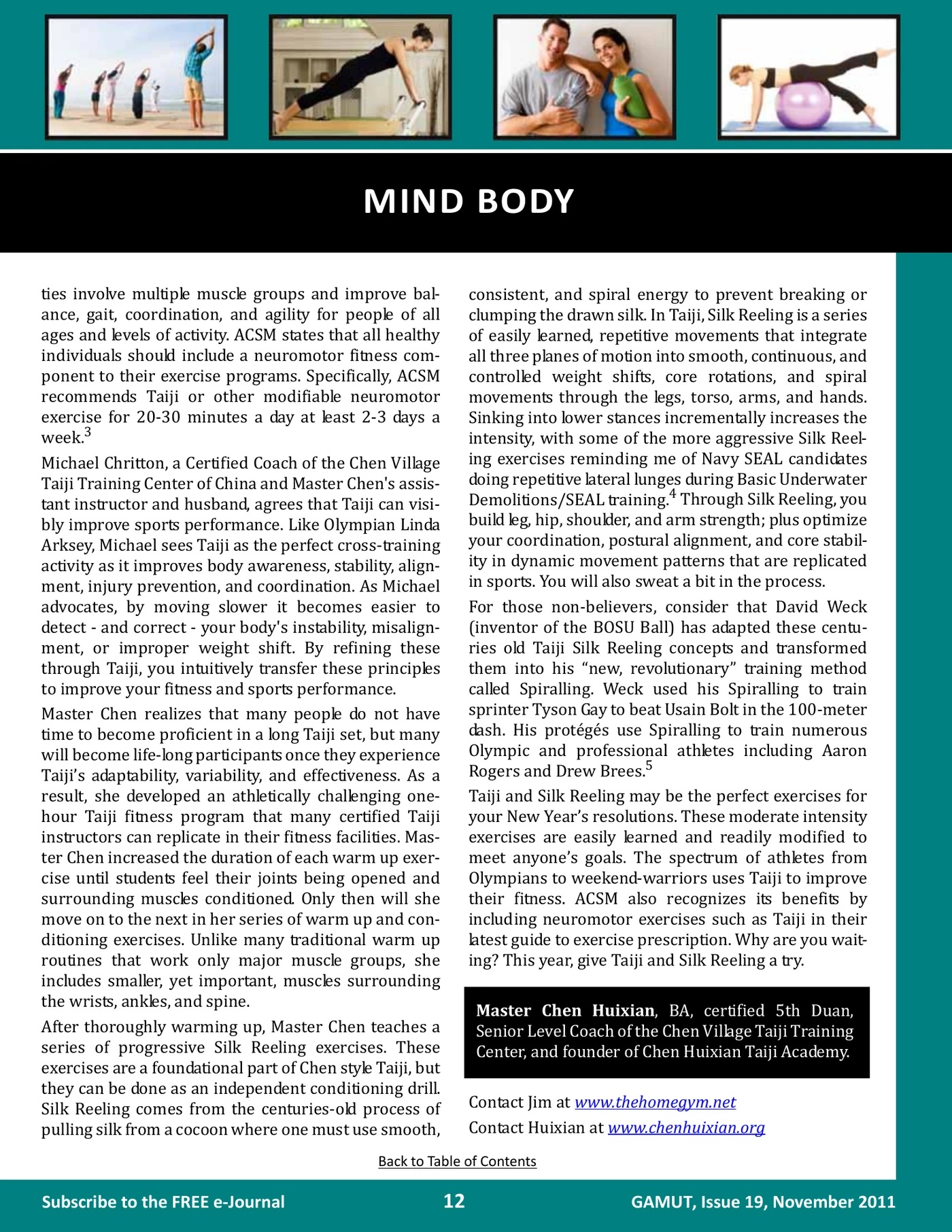
The December 2011 magazine cover and both original printed article pages are reproduced below in publication order.
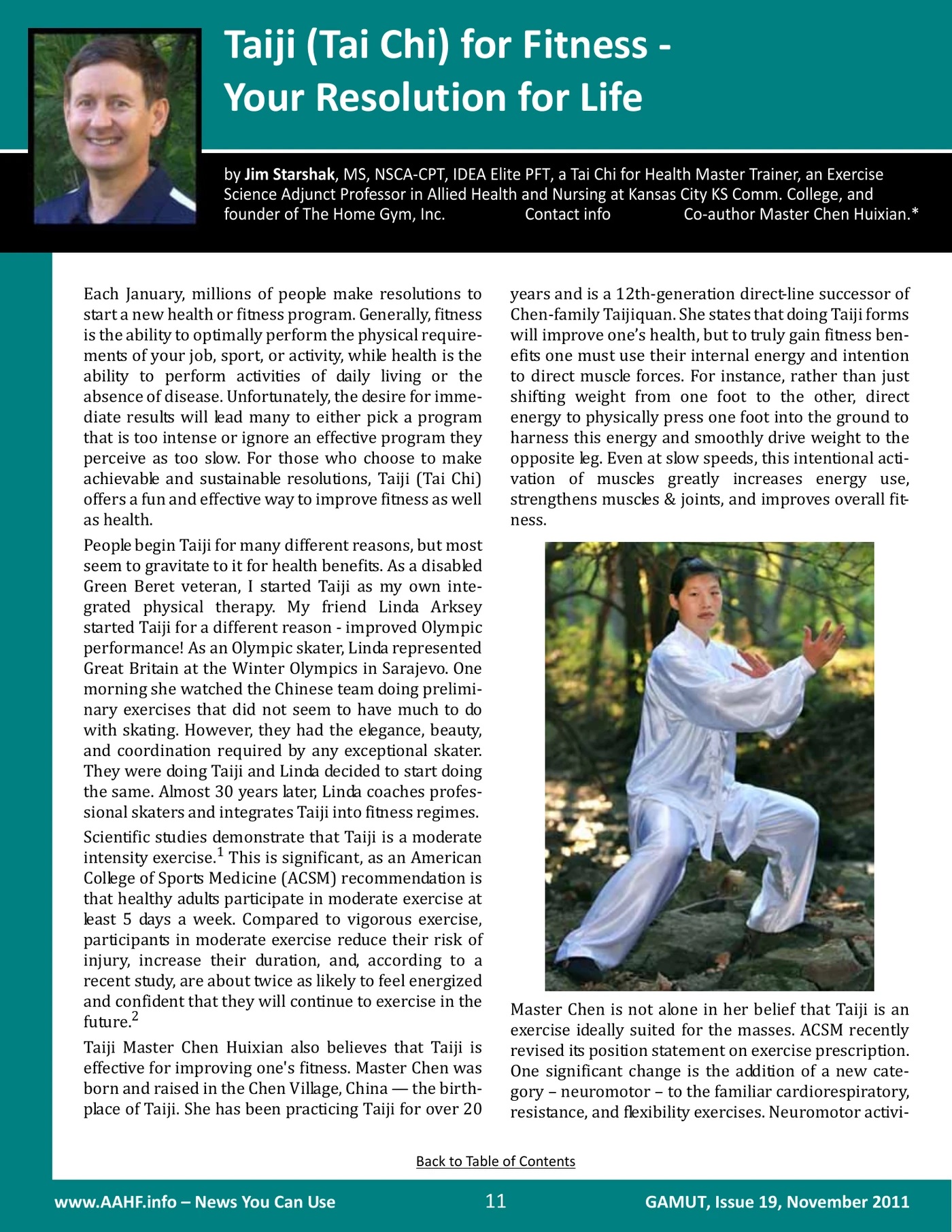
Each January, millions of people make resolutions to start a new health or fitness program. Generally, fitness is the ability to optimally perform the physical requirements of your job, sport, or activity, while health is the ability to perform activities of daily living or the absence of disease. Unfortunately, the desire for immediate results will lead many to either pick a program that is too intense or ignore an effective program they perceive as too slow. For those who choose to make achievable and sustainable resolutions, Taiji (Tai Chi) offers them a fun and effective way to improve their fitness as well as their health.
People begin Taiji for many different reasons, but most seem to gravitate to it for its multiple health benefits. As a disabled Green Beret Veteran, I started Taiji as my own integrated physical therapy. My friend Linda Arksey started Taiji for a different reason – improved Olympic performance! As an Olympic skater, Linda represented Great Britain at the Winter Olympics in Sarajevo. One morning she watched the Chinese team doing preliminary exercises that did not seem to have much to do with skating. However, they had the elegance, beauty, and coordination required by any good skater. They were doing Taiji and Linda decided to do the same. Almost 30 years later, Linda coaches professional skaters and integrates Taiji into their fitness regimes.
Scientific studies demonstrate that Taiji is a moderate intensity exercise. 1 This is significant as the American College of Sports Medicine (ACSM) recommends all healthy adults participate in moderate exercise at least 5 days a week. Compared to vigorous exercise, participants in moderate exercise reduce their risk of injury, increase their duration, and, according to a recent study, are about twice as likely to feel energized and confident that they will continue to exercise in the future. 2
Taiji Master Chen Huixian (www.chenhuixian.org) also believes that Taiji is effective to improve one's fitness. Master Chen was born and raised in the Chen Village in China – the birthplace of Taiji. She has been practicing Taiji for over 20 years and is a 12th-generation direct-line successor of Chen-family Taijiquan. She states that doing Taiji forms will improve one's health, but to truly gain fitness benefits one must use their internal energy and intention to direct their muscle forces. For instance, rather than just shifting your weight from one foot to the other, you direct your energy to physically press one foot into the ground to harness this energy and smoothly drive your weight to the opposite leg. Even at slow speeds, this intentional activation of your muscles greatly increases energy use, strengthens muscles & joints, and improves fitness. So doing this seemingly effortless Taiji can activate your muscles similar to doing 20-30 minutes of alternating single-leg squats.
Master Chen is not alone in her belief that Taiji is an exercise ideally suited for the masses. ACSM recently revised their position statement on exercise prescription. One significant change was the addition of a brand new category – Neuromotor – to the familiar cardiorespiratory, resistance, and flexibility exercises. Neuromotor activities involve multiple muscle groups and improve balance, gait, coordination, and agility for people of all ages and levels of activity. ACSM says all healthy individuals should include a neuromotor fitness component to their exercise programs. Specifically, ACSM recommends Taiji or other modifiable neuromotor exercise for 20-30 minutes a day at least 2-3 days a week. 3
Michael Chritton, a Certified Coach of the Chen Village Taiji Training Center of China and Master Chen's assistant instructor and husband, agrees that Taiji can visibly improve sports performance. Like Olympian Linda Arksey, Michael sees Taiji as the perfect cross-training activity as it improves body awareness, stability, alignment, injury prevention, and coordination. As Michael advocates, by moving slower it becomes easier to detect – and correct – your body's instability, misalignment, or improper weight shift. By refining these through Taiji, you intuitively transfer these principles to improve your fitness and sports performance.
Master Chen realizes that many people do not have time to become proficient in a long Taiji set, but many will become life-long participants once they experience Taiji's adaptability, variability, and effectiveness. As a result, she developed an athletically challenging one-hour Taiji fitness program that many certified Taiji instructors could replicate in their fitness facilities. Master Chen increased the duration of each warm up exercise until students feel their joints being opened and surrounding muscles conditioned. Only then will she move on to the next in her series of warm up and conditioning exercises. Unlike many traditional warm up routines that work only major muscle groups, she includes smaller, yet important, muscles surrounding the wrists, ankles, and spine.
After thoroughly warming up, Master Chen teaches a series of progressive Silk Reeling exercises. These exercise are a foundational part of Chen style Taiji, but they can be done as an independent conditioning drill. Silk Reeling comes from the centuries-old process of pulling silk from a cocoon where one must use smooth, consistent, and spiral energy to prevent breaking or clumping the drawn silk. In Taiji, Silk Reeling is a series of easily learned, repetitive movements that integrate all three planes of motion into smooth, continuous, and controlled weight shifts, core rotations, and spiral movements through the legs, torso, arms, and hands. Sinking into lower stances incrementally increases the intensity, with some of the more aggressive Silk Reeling exercises reminding me of Navy SEAL candidates doing repetitive lateral lunges on the grinder during BUD/S. 4
Through Silk Reeling, you will build leg, hip, shoulder, and arm strength, plus optimize your coordination, postural alignment, and core stability in dynamic movement patterns that are replicated in sports. You will also sweat a bit in the process. For those non-believers, consider that David Weck (inventor of the BOSU Ball) has adapted these century old Taiji Silk Reeling concepts and transformed them into his “new, revolutionary” training method called Spiralling. Weck used Spiralling to train sprinter Tyson Gay to beat Usain Bolt. His protégés currently use Spiralling to train numerous Olympic and professional athletes including Aaron Rogers and Drew Brees. 5
Taiji and Silk Reeling may be the perfect exercises for your New Year's resolutions. These moderate intensity exercises are easily learned, repetitive, and readily modified to meet anyone's goals. The spectrum of athletes from Olympians to weekend-warriors uses Taiji to improve their fitness. ACSM also recognizes its benefits by including neuromotor exercises such as Taiji in their latest guide to exercise prescription. Why are you waiting? This year, give Taiji and Silk Reeling a try. It may be the first time you actually make a resolution that you can keep all year long!
References
1. Li, JX. Hong, Y. Chan, KM. (2001). Tai chi: physiological characteristics and beneficial effects on health. Br J Sports Med 35:148-156.
2. Lowrey, F. (2011). Middle-aged women happier with moderate exercise. Thomson-Reuters. Accessed Sep. 30, 2011.
3. Gerber, CE, et.al. (2011). American College of Sports Medicine position stand. Quantity and quality of exercise for developing and maintaining cardiorespiratory, musculoskeletal, and neuromotor fitness in apparently healthy adults: guidance for prescribing exercise. Med Sci Sports Exerc. 2011 Jul;43(7):1334-59.
4. BUD/S – Basic Underwater Demolitions/SEAL (SEa, Air, Land) training course, Naval Special Warfare Command, Naval Amphibious Base Coronado, California.
5. Scott, P. (2011). The Revolutionary New Science of Speed, Men's Health, Rodale, Inc. Emmaus, PA.